
The Planned Parenthood Replacement Myth
How an anti-abortion "report" became a cornerstone argument for defunding reproductive healthcare despite weak evidence.

Author’s note: Citations for this article are at the end.
Keep your friends close and your enemies closer.
It’s amazing the things you learn when you subscribe to various Forced Birth Industrial Complex marketing emails. Aside from reconfirming for me how utterly insane these people are, subscribing helps me keep up on the latest unhinged proposal or lie being spread.
After reading one such email a few days ago, I became aware of another forced birth “report” whose certainty far exceeds the strength of its evidence.
The Culprits: Sidewalk Advocates for Life and The Charlotte Lozier Institute
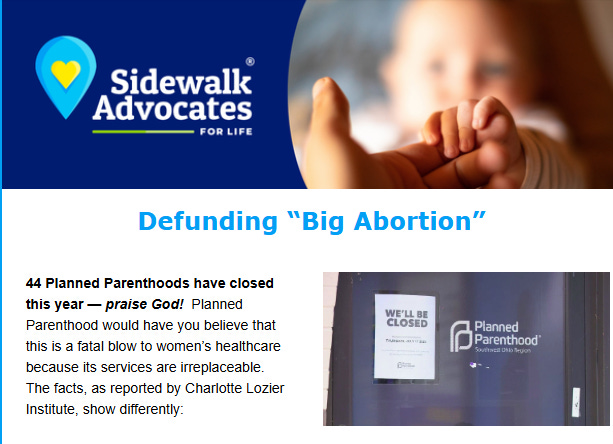
It all started with a casual glance at a marketing email from Sidewalk Advocates for Life (i.e., the professional clinic harassers of the Forced Birth Industrial Complex). I grew increasingly disgusted as the email reveled in clinic closures — especially Planned Parenthood clinics, their preferred “villain”.
After boasting about removing crucial preventive healthcare services from those who live in primarily low-income communities, they disingenuously assured readers that patients wouldn’t lose care because “alternatives” could absorb the demand.
The email cited a single source for that “reassurance,” because of course they did: A policy report from The Charlotte Lozier Institute titled “Defunding Big Abortion: Can Alternatives Fill the Gap?”
This “report” has become a cornerstone argument in Forced Birth Industrial Complex campaigns to redirect public funding away from abortion providers. It claims concerns about access are “unwarranted,” because a patchwork of other providers — federally qualified health centers (FQHCs), rural clinics, private physicians, and pregnancy centers — can meet patients’ needs.
Dangerously, that false claim is now circulating far beyond donor lists. It appears in legislative testimony, media commentary, and Republican policy proposals. If true, it would suggest clinic closures pose little risk to patients. But it’s quite the opposite. Let’s get into it.
Investigative analysis: First, what the Lozier report claims — and what it evades altogether
Claim: Other providers can absorb the patients.
Factcheck: There is no evidence that existing providers have sufficient capacity to replace specialized family-planning clinics at scale.
The report relies heavily on raw counts of FQHCs, rural health clinics, and physician offices to argue that the healthcare system can absorb displaced patients.
What it does not show is whether those providers have the capacity, staffing, funding, or specialized training to replace services concentrated in family-planning clinics. Many safety-net providers already operate in medically underserved areas with long wait times and workforce shortages.
Listing thousands of facilities nationwide obscures the geographic realities: Patients do not need a clinic “somewhere in America” — they need one within reach, accepting new patients, offering the needed services, and available on a timeline compatible with reproductive care.
Research on state exclusions of Planned Parenthood has documented declines in the use of long-acting contraception and disruptions in care continuity in affected regions. Those outcomes suggest that substitution is not frictionless — and may not be achievable at scale without significant new investment.
The report frames system “adaptation” as proof of adequacy, but this adaptation can include rationing, delays, or unmet need.
Claim: Pregnancy centers are part of the healthcare safety net.
Factcheck: Pregnancy centers generally do not provide comprehensive reproductive healthcare and are not equivalent to medical clinics.

The Institute describes pregnancy resource centers as an “important” option offering ultrasounds, STI testing, counseling, and material support.
This description conflates social services with medical care.
As I have reported often, many pregnancy centers are not licensed medical facilities, do not provide comprehensive reproductive healthcare, and do not offer contraception or abortion services. As much as the Forced Birth Industrial Complex pushes the idea that fake pregnancy centers can “replace abortion,” actual data continues to prove them to be the liars they are.
Even when clinical services are present at these centers, they are typically limited to confirming pregnancy rather than managing it medically. Counseling may be explicitly oriented toward discouraging abortion rather than presenting all evidence-based options.
The Trojan Horse — How Crisis Pregnancy Centers Masquerade as Care to Push Theocracy (Part 1 of 6)

The American anti‑abortion movement is upheld by a vast network of political, economic, and religious forces. What may appear at first as a grassroots effort to “save babies” is in fact powered by sophisticated crisis pregnancy center (CPC) networks, sli…
Public health literature and consumer-protection actions have documented concerns about centers presenting themselves as clinics while providing limited or ideologically filtered information, as well as putting private patient data at risk because they are not subject to HIPAA regulations.
Treating these organizations as interchangeable with medical providers effectively redefines the healthcare safety net to include entities not designed to deliver comprehensive care.
Claim: Pregnancy centers provided $452 million in services.
Factcheck: This is a misleading claim. The figure reflects estimated value of goods and activities, not documented healthcare spending or medical outcomes.

A related institute report cites “over $452 million” in services and goods delivered by pregnancy centers in a single year — a statistic frequently repeated in advocacy messaging. However, material items such as diapers, baby supplies, and parenting classes are aggregated with medical services to produce a single headline figure.
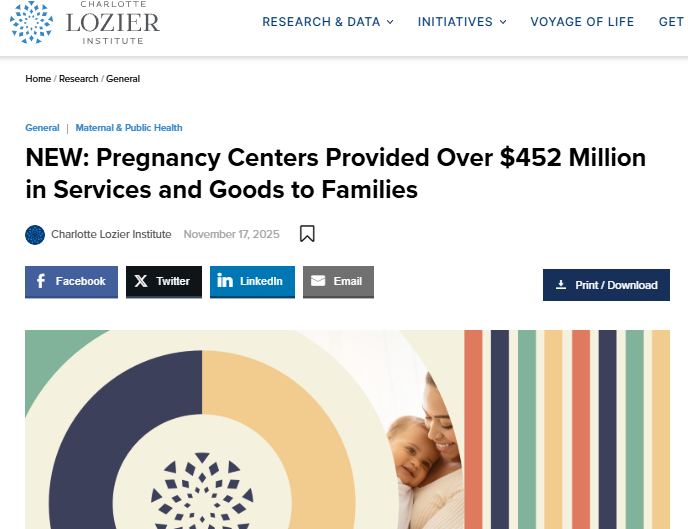
Side bar: I’d like readers to also note something insidious in the Lozier Institute’s stock image above that represents a larger trend: the Forced Birth Industrial Complex overwhelmingly relies on stock images of mothers of color with babies. This is deliberate. It allows these propagandists to present themselves as “compassionate and inclusive” while preying on and harming the very communities depicted. People of color — particularly Black women — already face higher rates of maternal mortality, lower access to healthcare, and greater economic barriers to raising children. Abortion bans intensify those inequities.
Legitimate public-health evaluation typically focuses on outcomes — prenatal care access, maternal health indicators, contraceptive coverage, or reductions in adverse events. A retail valuation of donated goods does not demonstrate that patients received medically necessary care.
Again, this negates their dubious claim that pregnancy centers are equipped to replace Planned Parenthood clinics — which provide legitimate medical services.
Claim: Past defunding efforts show Planned Parenthood is “replaceable.”
Factcheck: Evidence from affected states shows service disruptions and reduced access for many patients after provider exclusions.

The report cites state programs that removed abortion providers from funding streams and argues that healthcare systems adjusted.
Evidence from those states indicates adjustment often required additional public spending, outreach campaigns, and program redesigns — and in some cases followed measurable declines in service use. For example, research on Texas’ family-planning program after Planned Parenthood’s exclusion found reduced access to highly effective contraception in affected counties, particularly among low-income patients.
The Lozier analysis presents the existence of alternative providers as proof that access remained intact, while giving limited attention to whether patients actually received equivalent care.
What the methodology leaves out
Across claims, the report emphasizes structural indicators — number of facilities, estimated service value, existence of alternatives — while largely omitting operational metrics:
provider capacity
appointment availability
geographic accessibility
continuity of care
patient outcomes
Those omissions matter because reproductive healthcare is time-sensitive. Delays can turn manageable conditions into emergencies and reduce the effectiveness of preventive care.
A system may contain thousands of providers and still fail to deliver timely services to the people who need them most.
Follow the money: Where redirected funding actually goes
The Charlotte Lozier Institute does not operate in isolation. It is part of a broader advocacy ecosystem aligned with Forced Birth Industrial Complex policy goals, including the organization that serves as its parent political entity.
As states restrict funding to abortion providers, public dollars are often redirected into programs supporting pregnancy centers and related organizations. Investigations and audits have raised questions about oversight and accountability in some of these programs. For example:
In Pennsylvania, a state audit found that a contractor administering an alternatives-to-abortion program collected hundreds of thousands of dollars in fees and did not provide requested documentation for certain expenditures.
In Texas, investigative reporting documented tens of millions in taxpayer funding flowing to anti-abortion programs with limited oversight before reforms were introduced.
These examples illustrate a broader policy shift: Funds removed from medical providers are not simply saved; they are redistributed — frequently to ideologically aligned networks whose services differ substantially from clinical care.
This funding pipeline is why I call it “The Forced Birth Industrial Complex” — i.e., a highly connected far-right Christian-led system in which public money supports organizations focused on persuasion, surveillance, and material assistance rather than comprehensive reproductive healthcare.
Why this framing dupes so many people
The Lozier report’s core message — that abortion providers are unnecessary because alternatives already exist — is powerful precisely because it is simple. It can be condensed into talking points, campaign mailers, and legislative sound bites without the caveats and lived realities that complicate it… or outright prove them to be purposefully misleading the public.
Here’s the bottom line: Real healthcare infrastructure is not interchangeable with ideologically-led coercion factories.
Removing specialized providers while assuming general ones will compensate is a policy gamble whose risks always fall on patients, and very rarely on the organizations promoting the change.
Sidewalk Advocates for Life’s and The Charlotte Lozier Institute’s entire framing — that alternatives to Planned Parenthood exist — is a lie. If these people acted on good faith (hint: they NEVER do), the real question would be:
Can alternative organizations deliver equivalent care, at comparable scale, to the populations currently served?
And on that question, the available evidence proves that the answer is a big fat NOPE.
And they don’t care.
Citations
American College of Obstetricians and Gynecologists. "Increasing Access to Abortion: ACOG Committee Opinion, Number 815."ACOG Committee Opinion No. 815, November 2020.
Charlotte Lozier Institute. “Defunding Big Abortion: Can Alternatives Fill the Gap?” Sept. 16, 2025.
Federal Office of Rural Health Policy. “Health Workforce Data, Tools, and Dashboards.” Health Resources and Services Administration.
Ford, Chandra, et al. “Maternal and Infant Health Inequities, Reproductive Justice and COVID Addressed in RACE Series.” Ethnicity & Disease. Oct. 20, 2022.
Frederiksen, Brittni et al. “The Impact of Medicaid and Title X on Planned Parenthood.” Kaiser Family Foundation, April 16, 2025.
Guttmacher Institute. “Federally Qualified Health Centers Could Not Readily Replace Planned Parenthood.” May 17, 2017.
Kaiser Family Foundation. “Women’s Health Policy: Contraceptive Access and Coverage.”
McKenna J, Murtha T. “Designed to deceive: a study of the crisis pregnancy center industry in nine states.” Available from: https://alliancestateadvocates.org/wp-content/uploads/sites/107/Alliance-CPC-Study-Designed-to-Deceive.pdf [Accessed Feb. 28, 2026]
Stevenson, Amanda et al. “Effect of Removal of Planned Parenthood from the Texas Women’s Health Program.” New England Journal of Medicine, March 2016.
Swartzendruber A et al. “Contraceptive information on pregnancy resource center websites: a statewide content analysis.” Contraception. 2018.
Treder, Kelly et al. “Abortion Bans Will Exacerbate Already Severe Racial Inequities in Maternal Mortality.” Women’s Health Issues, July-Aug. 2023.
If you liked this article and haven’t already, please consider a free or paid subscription, so you can get my updates directly in your inbox! I can’t wait to show you more.
Colleen Luckett — independent journalist, unapologetic feminist, and veteran abortion rights advocate — reports on the war against reproductive justice in the United States, where religion, patriarchy, and profit form an UNholy trinity. Featuring Miscarriage of Justice, a series that brings you the receipts on the pervasive corruption and weaponized stigma behind pregnancy criminalization. Plus some other anti-capitalist things. :-) You can also find her on Instagram, TikTok, Threads, and YouTube, and listen to The Abortionfluencer Podcast wherever you get your podcasts.
This was a great piece. I was a planned parenthood nurse practitioner and director for 4 years. The state harassed us regularly and kept us buried in frivolous litigation nonstop. Sometimes it was state mandated assault (unnecessary pelvic exams before a medication abortion which prompted more legal action). Now in my state, only one abortion clinic can stand and sees very few patients because of the extensive TRAP laws. Our wellness clinics are closing because of the ongoing attacks. I saw women with advanced stage cancers. Referred a young man with testicular cancer. Treated many patients from all walks of life. Now our tax dollars fund fake propaganda clinics. It is dystopia here in Missouri.
Thank you for this article, Colleen. I'm surprised more people aren't talking about this as scaling back health care access is such a concern right now.
The Antiabortion Industrial Complex ignores the fact that there are full-time jobs at hospitals, clinics, etc. dedicated to working with just insurance and Medicare/Medicaid, billing, claims, and so forth. It's an immense part of health care that gets overlooked, it seems.