
America’s Missing Enlightenment Laid the Groundwork for Our Dawning Dark Age
An unfinished American revolution is weakening every modern movement for human rights — and it MUST change.

I spent this weekend largely offline, trying to recover from a kind of soul-level defeat that has become uncomfortably familiar since I founded The Abortionfluencer platform a few years ago.
In the days leading up to Randall Terry’s illegal blockade at the Memphis Planned Parenthood last Friday, Dec. 5th, I spent hours trying to mobilize activists on the ground to stand in solidarity with staff and patients. I wrote a full investigative piece — “‘Operation Rescue’ Extremists Quietly Preparing Their Clinic Invasion Comeback Tour” — and produced two videos: Part I on the history of the Operation Rescue movement, and Part II on their rebooted Memphis Resurrection Rescue campus and planned clinic blockade.
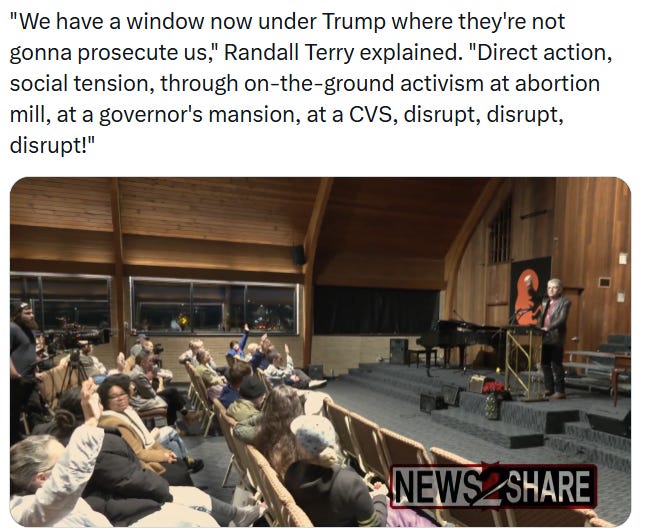
The day before their planned, illegal blockade, I put out one more video plea to mobilize activists on the ground in Tennessee. I circulated all of this widely across multiple platforms — my friends and followers engaged with it, shared it.
And then I tagged a couple content creators in the area with far larger platforms — people who publicly frame themselves as champions of bodily autonomy and digital activism — and one of my Tennessee contacts sent them a request as well. And the response was…. crickets. Deafening radio silence, yet again.
It brought back the sting I felt from a previous failed moment for reproductive justice: Following the overturning of Roe v. Wade, other activists and I wasted hours of our time trying to build momentum for a nationwide women’s strike. I reached out to creators, influencers, and organizations with big audiences and deep resources. And the effort went nowhere. Not because the idea lacked urgency, but because solidarity and collective power is not algorithmically or economically rewarded — and many Democrat party “movement voices” are now accountable first and foremost to billionaire-backed pipeline programs that have been exposed by technology journalist Taylor Lorenz and others.
You see, in spaces where public influence is funded, coordinated, and branded, our urgent, grassroots calls to action become inconvenient interruptions.
By Friday afternoon, I finally stepped away from the Internet for a breather. Not because of burnout this time, but because I was heartsick and disappointed. Not in individuals, but in patterns. Patterns that reveal how deeply modern activism mirrors the unresolved contradictions of the nation itself.
Today, those patterns snapped into focus again when filmmaker Jade Singleton popped up on my Substack algorithm, brilliantly sharing an insight that now feels foundational: the United States never “survived its own birth” — and never truly experienced an Enlightenment like the one that transformed Europe. We adopted the vocabulary — rights, liberty, equality — without undergoing the philosophical upheaval that gave those words meaning for ALL Americans.
(Singleton’s documentary work interrogates these contradictions with a clarity our political institutions rarely muster. 👉 Follow her.)
The more I sit with her astute observations, the more clearly I see how this unresolved history reverberates through our justice movements.
Borrowed Language Without Structural Transformation
The Enlightenment was not merely a period of scientific discovery. It was a long, destabilizing confrontation with inherited power — a philosophical insistence that human dignity, rights, and self-governance could not belong exclusively to monarchs, landowners, or a single class.
Europe lived through that turbulence. Its institutions shifted — inconsistently, imperfectly, but undeniably. America imported Enlightenment rhetoric, but not the transformation.
Our white, male, slave-owning Founding Fathers dutifully quoted Locke, Rousseau, and Montesquieu — invoking natural rights and social contracts — while simultaneously constructing a republic that entrenched their own dominance through:
Slavery
Indigenous genocide
Patriarchal law
Racial caste systems
Property-based citizenship
Instead of uprooting the ideology that built the nation, the country reintegrated its stewards. And that gap — that unresolved moral contradiction — has shaped every institution we live under today.
The Structures We Never Dismantled
The United States has had multiple opportunities to confront its foundational hierarchies. Each time, it chose capitalist, patriarchal exploitation over transformation.
The Confederacy Was Never Truly Defeated
After the Civil War, America repeated the founding pattern: big promises with no structural reckoning, no consequences.
Former Confederate politicians and military leaders returned to public office.
No one was executed for treason.
Institutions such as police departments and courts absorbed former Confederates without reform.
The “Lost Cause” rewrote history, shaped textbooks, and justified Jim Crow.
Reconstruction was abandoned, allowing white supremacist terrorism to flourish with impunity.
Without accountability, Confederate ideology metastasized into modern governance.
Racial Hierarchies Were Rebuilt Through Law
Rather than dismantling white supremacy, the nation codified it:
The Fugitive Slave Act (before the war) empowered white citizens to police and abduct Black people anywhere in the country.
Plessy v. Ferguson (1896) legalized segregation and cemented second-class citizenship.
Jim Crow laws enforced racial subjugation for nearly a century (and, by the way, inspired the Nazi regime’s psychopathic, authoritarian vision for 1930s Germany).
These laws became the architecture of American governance.
Economic and Social Rights Were Never Universalized
Even 20th-century “progress” — when “states rights” really became a dog whistle for institutionalized racism — excluded the people most harmed. Some examples:
The GI Bill, the cornerstone of the modern middle class, was administered locally to allow white officials to deny benefits to Black veterans.
New Deal labor protections excluded domestic and agricultural workers — roles disproportionately held by Black, Indigenous, and immigrant men and women.
Redlining systematically devalued Black neighborhoods and denied access to credit, wealth, and stability.
Indigenous communities were isolated and deprived of rights through federal policies that confined Native nations to reservations, restricted movement, dismantled land bases, and created enforced dependency on underfunded federal programs.
These exclusions ensured racial capitalism remained intact.
A National Gun Obsession Rooted in Racial Control
Unlike Enlightenment-influenced nations, American gun ideology grew from:
frontier expansion
Indigenous dispossession
slave patrols
vigilante enforcement of white supremacy
anti-government grievance as identity
the belief that whiteness confers the right to violence
The Second Amendment became not a philosophy of civic responsibility, but a justification for unrestrained domination. We normalized violence in the name of capitalism as “liberty” and “democracy” — and exported the consequences to every corner of the world.
COINTELPRO and the Roots of Reproductive Justice Suppression
The U.S. government has long targeted Black leaders in the U.S. — but less attention has been focused on those whose work aligns with what we now recognize as reproductive justice. COINTELPRO’s surveillance and disruption efforts also included:
Fannie Lou Hamer — targeted for exposing Mississippi’s epidemic of forced sterilizations (“Mississippi appendectomies”) and linking bodily autonomy to racial justice.
Angela Davis — surveilled and labeled a national threat for connecting the criminalization of Black women, prison conditions, and reproductive freedom.
Black Panther Party women leaders (including Ericka Huggins, Elaine Brown, Assata Shakur, and Kathleen Cleaver) — targeted for building free community clinics, prenatal care programs, and survival initiatives that supported families, maternal health, and community autonomy.
Young Lords women leaders (including Denise Oliver-Vélez and Iris Morales) — monitored for organizing against unsafe hospital conditions, medical racism, and coercive sterilization in Puerto Rican and Black communities.
These organizers defended the right to give birth, to parent in safe and supported communities, to access healthcare, and to live free from state violence. Rather than dismantling the systems harming their communities, the U.S. government targeted the leaders who tried to transform them.
Modern Movements Haven’t Fared Much Better
Every time ordinary Americans have tried to confront concentrated wealth or state violence, the pattern repeats: The donor class mobilizes and leads with “divide and conquer” propaganda, politicians either support them or retreat, and the movement is either crushed outright or absorbed and neutralized. For example:
Occupy Wall Street named the truth America’s elites feared most: economic inequality is structural. The response was swift — mass arrests, coordinated police crackdowns, and a bipartisan effort to shut down encampments while avoiding any confrontation with Wall Street itself.
Black Lives Matter forced the nation to acknowledge the continuity between slavery, policing, and racialized state violence. Instead of restructuring those systems, Democratic and Republican leaders alike deployed militarized police, expanded surveillance, and funneled public outrage into corporate statements and symbolic gestures that preserved the underlying hierarchy.
Standing Rock exposed the fusion of corporate power, environmental racism, and militarized policing. Under an Obama presidency, water protectors were met with armored vehicles, rubber bullets, felony charges, and state violence while Democratic officials largely stayed silent and Republicans openly cheered the repression. The pipeline was completed anyway — a victory for the fossil-fuel donor class.
Me Too unmasked the pervasiveness of sexual abuse and misogyny in homes, workplaces, and political institutions. But once the headlines faded and wealthy abusers lawyered up, the movement was channeled into HR trainings, corporate “initiatives,” and political messaging — while the structural conditions that enable gendered violence remained intact and continue to gain power.
Each of these movements cracked open the possibility of real transformation.
And each time, the backlash — from billionaires, corporations, and greedy status-quo politicians in both parties — ensured that the system reabsorbed the shock.
Our Reproductive-Rights Ecosystem Reproduces the Nation’s Contradiction
I actually wrote about something similar to this lack of Enlightenment — or a reckoning — last spring. In my piece, “From Jane Collective to Sponsorship Tiers: How ‘Girl Bosses’ & Non-Profits Stole Our Collective Liberation,” I argued that mainstream reproductive-rights organizations, led by white feminists, adopted the language of liberation — choice, empowerment, autonomy — without adopting its structural demands.

The movement drifted away from the radical, community-rooted organizing traditions led by Black feminists, Indigenous women, and grassroots abortion activists toward a more donor-driven nonprofit model, where messaging often mattered more than material outcomes, and access to influence became increasingly gatekept.
The “girl boss”-led nonprofit industrial complex took a movement that once centered collective liberation and turned it into:
PAC strategy slide decks,
fundraising galas,
“empowerment” merch,
leadership pipelines restricted to mostly white professional-class women,
siloed issue advocacy,
branding over solidarity.
When liberation becomes a career ladder, the ladder gets more attention than the liberation. And, yet again, this pattern echoes the same patterns Singleton observed: Mainstream organizations absorbed the language of feminism — choice, empowerment, bodily autonomy — without undergoing the structural shifts demanded by Black feminists, Indigenous women, working-class organizers, and abortion providers on the ground.
Rhetoric Without Reconstruction Always Creates Space for Punishment
When a society refuses to confront its foundational hierarchies, those hierarchies evolve rather than disappear. And when movements adopt the vocabulary of liberation without challenging those structures, the most vulnerable are left without protection.
We see this now in the rapid escalation of pregnancy criminalization.
Pregnant people — overwhelmingly Black, Brown, Indigenous, poor, and disabled — are being surveilled, charged, imprisoned, and punished for miscarriages, stillbirths, substance use, or simply being in crisis. Prosecutors, child-welfare agencies, and fake Christian pregnancy centers have quietly expanded their reach, often without national scrutiny.
“The pro-life versus pro-choice paradigm serves to both reify and mask the structures of white supremacy and capitalism that undergird the reproductive choices that women make. While both camps of the pro-choice and pro-life debate give lip service to addressing the concerns of women of color, in the end the manner in which both articulate the issues at stake contributes to their support of political positions that are racist and sexist and which do nothing to support either life or real choice for women of color.” - Andrea Smith, NWSA Journal, 2005.
Reproductive-justice leaders — especially Black women — warned for decades that this would happen. They understood that attacks on bodily autonomy would land first and hardest on those already targeted by racialized state violence. And in a country that never confronted these institutionalized hierarchies, pregnant women of color become the easiest targets for:
state violence
criminalization
surveillance
family separation
punitive probation
“fetal personhood” policing
medical neglect/discrimination
Pregnancy criminalization is not an anomaly. It is the predictable outcome of a nation that never resolved its foundational contradictions and a movement that struggled to confront the full breadth of the threat.
And this lack of accountability is why I launched my featured series here on Substack, Miscarriage of Justice, in the first place. I was fed up with watching pregnant people — overwhelmingly women of color — being prosecuted, punished, or abandoned, while the national conversation not only continued to center the fetus but also focused on electoral strategy, branding, or the latest press cycle.
These women deserve witnesses. They deserve ongoing coverage (not just persecution in headlines and then forgotten). Not many are doing it. So I decided to leverage my white privilege and do something myself.
Sidenote: Follow Pregnancy Justice for the critical work they do in documenting and fighting against the criminalization of pregnancy in the United States.
But Here’s The Thing: I Don’t Want to “Do It Myself”
I want real change. I want solidarity. I want collaborators who care more about serving the public than about protecting their brand or cultivating proximity to billionaire-funded influence networks.
✔️ I want a movement that fights for pregnant people with the same urgency it fights for political optics and rage-bait content.
✔️A movement grounded in the needs of those most targeted — not in the branding of high-visibility creators whose work ultimately serves corporate Democrat party interests and a status quo that leaves so many people behind.
✔️A movement that recognizes that protecting bodily autonomy requires aggressively confronting and challenging the institutionalized systems that criminalize the most vulnerable among us.
The liberal content creators who dominate the attention economy may be financially rewarded for their performances of outrage, but y’all, performances do not change material conditions. People do. Organizers do. Journalists do. Communities do.
And this is where Singleton’s beautiful insight gave me so much clarity: The reason reproductive injustice feels so sidelined — the reason our movements fracture, stall, and get absorbed into branding instead of transformation — is because this country never underwent the Enlightenment that would have centered human dignity as our organizing principle. And that unfinished revolution still shapes every failure we’re fighting through.
But despite everything, I remain an optimist. I continue to believe a different future is possible … a true cultural and political Enlightenment for today that is rooted in collective dignity rather than individual branding and clout-chasing.
In other words, “the revolution won’t be televised” — because America’s long-overdue Enlightenment doesn’t fit into a sponsored reel, inflammatory news broadcast, or corporate training video. It belongs to us.
Fueled by green smoothies and Gen X grit, Colleen Luckett is part literary witch, part intersectional feminist warrior calling out forced birthers, capitalist co-opters, and faux-feminists — strong-willed, justice-rooted, and done playing nice with fascists. Featuring Miscarriage of Justice, a series that brings you the receipts on the structural racism and misogyny, pervasive corruption, and weaponized stigma behind pregnancy criminalization. You can also find her on Instagram, TikTok, and YouTube, and listen to The Abortionfluencer Podcast wherever you get your podcasts.
This framing of Amerca's incomplete Enlightenment is unusually sharp and explains so much about why grassroots organizing keeps running into the same structural walls. The point about borrowed vocabulary without the philosophical upheaval thatgave those words meaning feels especially relevant when looking at how modern movements get absorbed into branding cycles rather than actually restructuring power. What's tough is that even when we name these patterns, the donor-driven infrastructure actively punishes the kind of solidarity work that would challenge them insted of rewarding it algorithmically.